
Introduction
Complete dentures remain a cost-effective and minimally invasive option for rehabilitating edentulous patients. Despite advances in digital dentistry, polymethyl methacrylate (PMMA) continues to be the preferred denture base material due to its favourable esthetics, ease of processing, affordability, and proven clinical performance [1]. However, conventional heat-polymerized PMMA exhibits limitations such as reduced flexural strength, polymerization shrinkage, residual monomer release, and porosity, which may compromise denture durability and tissue health [2,3]. Additionally, the conventional fabrication process is technique-sensitive and prone to dimensional inaccuracies [4].
Recent developments in CAD/CAM technology have introduced pre-polymerized PMMA discs fabricated under controlled conditions, resulting in improved homogeneity, reduced residual monomer content, superior surface quality, and enhanced mechanical properties [5,6]. Since dentures are subjected to complex functional stresses intraorally, adequate flexural strength is essential to resist fatigue and fracture, particularly in tissue-supported prostheses [7-9]. Therefore, this study aimed to compare the flexural strength of conventional DPI heat-cured PMMA and pre-polymerized pink PMMA CAD/CAM disc material.
The null hypothesis of the present study states that there is no significant difference in the flexural strength between specimens fabricated using conventional DPI heat-cured polymethyl methacrylate (PMMA) and those fabricated using pre-polymerized pink PMMA CAD CAM disc material.
Materials and Methods
A total of 40 rectangular specimens (64 × 10 × 3 mm) were fabricated and divided into two groups (n = 20). Group 1 specimens were fabricated using conventional heat-cured polymethyl methacrylate (PMMA) denture base resin (FIG 1) by the compression molding technique. Wax patterns were obtained using an addition silicone putty index prepared from a CAD/CAM-milled PMMA master specimen. Flasking was performed in a three-part denture flask, followed by dewaxing. PMMA resin mixed in a 3:1 polymer-to-monomer ratio was packed at the dough stage. Trial closure was carried out at 1500 psi, followed by final closure at 3500 psi with bench curing for 30 minutes. Polymerization was performed at 74 °C for 90 minutes, followed by 100 °C for 30 minutes. The specimens were then bench-cooled, deflasked, trimmed, finished, and polished (FIG 2).
Group 2 specimens were fabricated from pre-polymerized pink PMMA Ivotion Base CAD/CAM denture base discs (FIG 3) using a PrograMill PM7 milling machine (Ivoclar). Specimens were digitally designed using Meshmixer software, exported as STL files (FIG 4), and milled in a vertical orientation following manufacturer-recommended protocols. After milling, specimens were detached, inspected for surface defects, and finished and polished (FIG 5). All specimens were finished using silicon carbide abrasive papers (P120 and P600) and polished with a silicone rubber wheel and pumice slurry at 3000 rpm. Final dimensions were verified using a digital vernier caliper before testing.
All specimens from Groups 1 and 2 were sequentially numbered and subjected to flexural strength testing using a three-point bending test. Each specimen was positioned symmetrically on a three-point bending jig with two circular supports spaced 50 mm apart. Flexural testing was performed using a universal testing machine (FIG 6), equipped with an upper anvil and load cell, with the load applied vertically at the center of the specimen at a constant crosshead speed of 5 mm/min. Fracture was identified by a sudden drop in load, and the maximum load at failure (N) was automatically recorded by the testing software.
Results
Table1 compared the mean flexural strength of specimens fabricated by DPI – Heat cure polymethyl methacrylate and Pre polymerized pink PMMA CAD-CAM Ivotion disc material using student t test showing p value of 0.001.
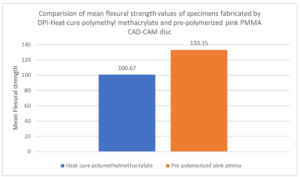
The mean flexural strength of DPI heat-cured polymethyl methacrylate was 100.67MPa with standard deviation of 6.00 MPa, while that of the pre-polymerized pink PMMA CAD-CAM Ivotion disc material was 133.15 MPa with standard deviation of 5.13 MPa.
The bar diagram representation [FIG 7] depicts comparison of mean difference in flexural strength between DPI – Heat-cure polymethyl methacrylate and pre-polymerized pink PMMA CAD-CAM disc material.
Discussion
Complete dentures remain the most conservative and cost-effective treatment for edentulous patients, and despite advances in digital fabrication, polymethyl methacrylate (PMMA) continues to be the most widely used denture base material [1]. Although conventional heat-cured PMMA offers acceptable esthetics, ease of processing, and affordability [2], it is associated with limitations such as lower flexural strength, residual monomer content, and porosity, which adversely affect mechanical performance and longevity. [10].
Porosity within the resin matrix acts as a stress concentrator, reducing resistance to cyclic masticatory loads and increasing susceptibility to crack initiation and fracture. These shortcomings are influenced by processing variables including polymer-to-monomer ratio, curing cycle, air entrapment, and incomplete polymerization. The introduction of CAD/CAM technology utilizing pre-polymerized PMMA discs fabricated under controlled industrial conditions has addressed many of these limitations by producing dense, homogeneous materials with minimal porosity and reduced residual monomer content [11], which have resulted in superior mechanical properties, dimensional stability, surface quality, and biocompatibility [1,2,12].
Flexural strength is a critical parameter for denture base materials as it reflects resistance to bending stresses encountered during mastication, particularly in high-stress regions such as the mid-palatal area [12].
In this study, Student’s t-test revealed a statistically significant difference in mean flexural strength between the groups (p = 0.001), with CAD/CAM PMMA demonstrating higher values (133.15 ± 5.13 MPa) compared to conventional DPI heat-cure PMMA (100.67 ± 6.00 MPa), confirming the superior mechanical performance of the CAD/CAM material. These findings are consistent with previous studies by Al-Dwairi et al. [12], which reported greater resistance to deformation, fatigue, and fracture in CAD/CAM-milled denture base resins compared to compression-moulded conventional PMMA. Despite these promising results, the present study was limited by its in-vitro design, which does not fully replicate the complex oral environment, and by the evaluation of flexural strength alone, without assessing other clinically relevant properties such as impact strength, surface hardness, wear resistance, and water sorption.
Despite the favourable results, this in vitro study does not fully simulate the complex oral environment and was limited to the assessment of flexural strength. Hence, further in vitro and clinical investigations are recommended to validate these findings and to evaluate additional properties such as impact strength, wear resistance, and biocompatibility.
Conclusion
It can be concluded that CAD/CAM-milled pre-polymerised PMMA specimens demonstrated significantly greater flexural strength than conventionally processed heat-cured PMMA specimens. This superior mechanical performance is likely due to enhanced polymerisation, reduced porosity, and precise fabrication under controlled industrial conditions, supporting the use of CAD/CAM PMMA as a more durable alternative for denture base fabrication.
[12].
References
- Casucci A, Verniani G, Barbieri AL, Ricci NM, Ferrari Cagidiaco E, Ferrari M. Flexural strength analysis of different complete denture resin-based materials obtained by conventional and digital manufacturing Materials. 2023;16(19):6559.
- Aguirre BC, Chen JH, Kontogiorgos E, Murchison DF. Flexural strength of denture base acrylic resins processed by conventional and CAD-CAM methods. J Prosthet Dent. 2020;123(4):641-646.
- Limírio JPJO, Barbosa GAS, de Souza RF, Lovato da Silva CH. Flexural strength and flexural modulus of CAD-CAM and heatpolymerized PMMA resins: A systematic review and meta-analysis of in vitro studies. J Prosthet Dent. 2021;126(4): e1–e8
- Abualsaud R, Gad MM. Flexural strength of CAD/CAM denture base materials: Systematic review and meta-analysis of in-vitro studies. J Int Soc Prev Community Dent. 2022;12(2):160–170.
- Srinivasan M, Kalberer N, Kamnoedboon P, Mekki M, Durual S, Özcan M, et al. CAD-CAM complete denture resins: An evaluation of biocompatibility, mechanical properties, and surface characteristics. J Dent. 2021; 111:103785.
- Mubaraki MQ, Al Moaleem MM, Alzahrani AH, Shariff M, Alqahtani SM, Porwal A, et al. Assessment of conventionally and digitally fabricated complete dentures: A comprehensive review. Materials (Basel). 2022;15(11):3868.
- Gharechahi J, Asadzadeh Aghdaee N, Shahabian F, Gharechahi M. Flexural strength of acrylic resin denture bases processed by two different methods. J Dent Res Dent Clin Dent Prospects. 2014;8(3):148–52
- Chhabra M, Kumar MN, Raghavendra Swamy KN, Thippeswamy HM. Flexural strength and impact strength of heat-cured acrylic and 3D printed denture base resins: A comparative in vitro study. J Oral Biol Craniofac Res. 2021;11(4):530–534.
- Diaz-Arnold AM, Vargas MA, Shaull KL, Laffoon JE, Qian F. Flexural and fatigue strengths of denture base resin. J Prosthet Dent. 2008;100(1):47–51.
- Meng TR Jr, Latta MA. Physical properties of four acrylic denture base resins. J Contemp Dent Pract. 2005;6(4):93–100.
- Infante L, Yilmaz B, McGlumphy E, Finger I. Fabricating complete dentures with CAD/CAM technology. J Prosthet Dent 2014; 111:351-355.
- Al-Dwairi ZN, Tahboub KY, Baba NZ, Goodacre CJ. A comparison of the flexural and impact strengths and flexural modulus of CAD/CAM and conventional heat-cured polymethyl methacrylate (PMMA). J Prosthodont. 2018;29(4):341–349.
Figures
FIG 1: DPI Heat cure denture base acrylic material
Fig 2: Group 1 – 20 DPI Heat cure Acrylic Specimens fabricated using Conventional compression molding technique
FIG 3: IVOCLAR Pre polymerized Pink PMMA Ivotion base CAD-CAM Disc
FIG 4: Polyvinyl siloxane putty matrix for wax duplicates
FIG 5: Group 2- 20 pre-polymerized pink PMMA Ivotion base CAD-CAM Milled specimens
FIG 6: Universal Testing Machine
Table 1: Shows the intragroup analysis of mean flexural strength of specimens fabricated by DPI-Heat cure polymethyl methacrylate and pre-polymerized pink PMMA CAD-CAM Ivotion disc using Student t test.
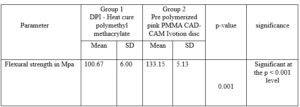
FIG 7: The bar diagram representation depicts comparison of mean difference in flexural strength between DPI – Heat-cure polymethyl methacrylate and pre-polymerized pink PMMA CAD-CAM disc material.